5 simple ways to see how well you’re aging
By Dr. Nathalie Beauchamp, DC
Most people think of longevity as something determined by genetics, the absence of disease, or the right habits and lifestyle choices. And while those factors certainly matter, there is another layer that often gets overlooked: how well your body still functions in real life. In fact, researchers have identified several simple fitness tests that predict longevity, offering valuable insight into future health, independence, and quality of life.
Research suggests that basic measures of balance, strength, mobility, and walking speed are strongly linked with future health outcomes, including mortality risk and independence later in life.(1) In other words, the way you move through ordinary tasks—standing up from a chair, recovering after a stumble, or walking at a brisk pace—may say more about your long-term trajectory than your age or even your latest set of bloodwork.
These abilities depend on muscle strength, balance, coordination, joint mobility, and cardiorespiratory fitness, all of which naturally decline with age if they are not actively maintained. In practical terms, people who move well tend to be better protected against falls, disability, and loss of independence—all of which are essential for healthy aging.
The good news is that these fitness tests that predict longevity can be performed at home in just a few minutes, yet they are among the strongest everyday indicators of mobility, resilience, and independence as you age.
Before diving into them, it’s important to understand what they’re really measuring, because living a long time and aging well are not necessarily the same thing.
Healthspan vs. lifespan
Lifespan is simply how many years you live. Healthspan is how many of those years you spend in good health, with enough physical and cognitive function to stay independent and do the things you want to do. The two often get treated as the same goal, but they’re not, and the difference is significant. Living longer isn’t the same as aging well, and it’s possible to add years to your life while watching the quality of those years decline if your strength, balance, and mobility fade too far.
This distinction is what makes the simple tests so useful. They point toward healthspan rather than lifespan. They show whether your body still has the reserve to manage real life, things like carrying groceries, recovering from a stumble, climbing stairs, getting out of a low chair, or getting down on the floor and back up again. Those are the everyday capacities that keep a person independent, and when they begin to slip, the risks of falls, disability, and hospitalization climb with them.
A lot of people only learn about their health through medical tests that happen once or twice a year. Those are absolutely important, but they may be missing a piece of the puzzle. You can have perfectly acceptable lab numbers and still be physically deconditioned. You can also have a few imperfect numbers and still move well, recover well, and maintain a strong reserve. That is why movement-based testing is so valuable.
Best of all, you don’t need a lab to measure any of it. The five tests below take only a few minutes each, require almost no equipment, and give you a clear sense of how well your body is actually functioning.
5 fitness tests that predict longevity
1. Grip strength
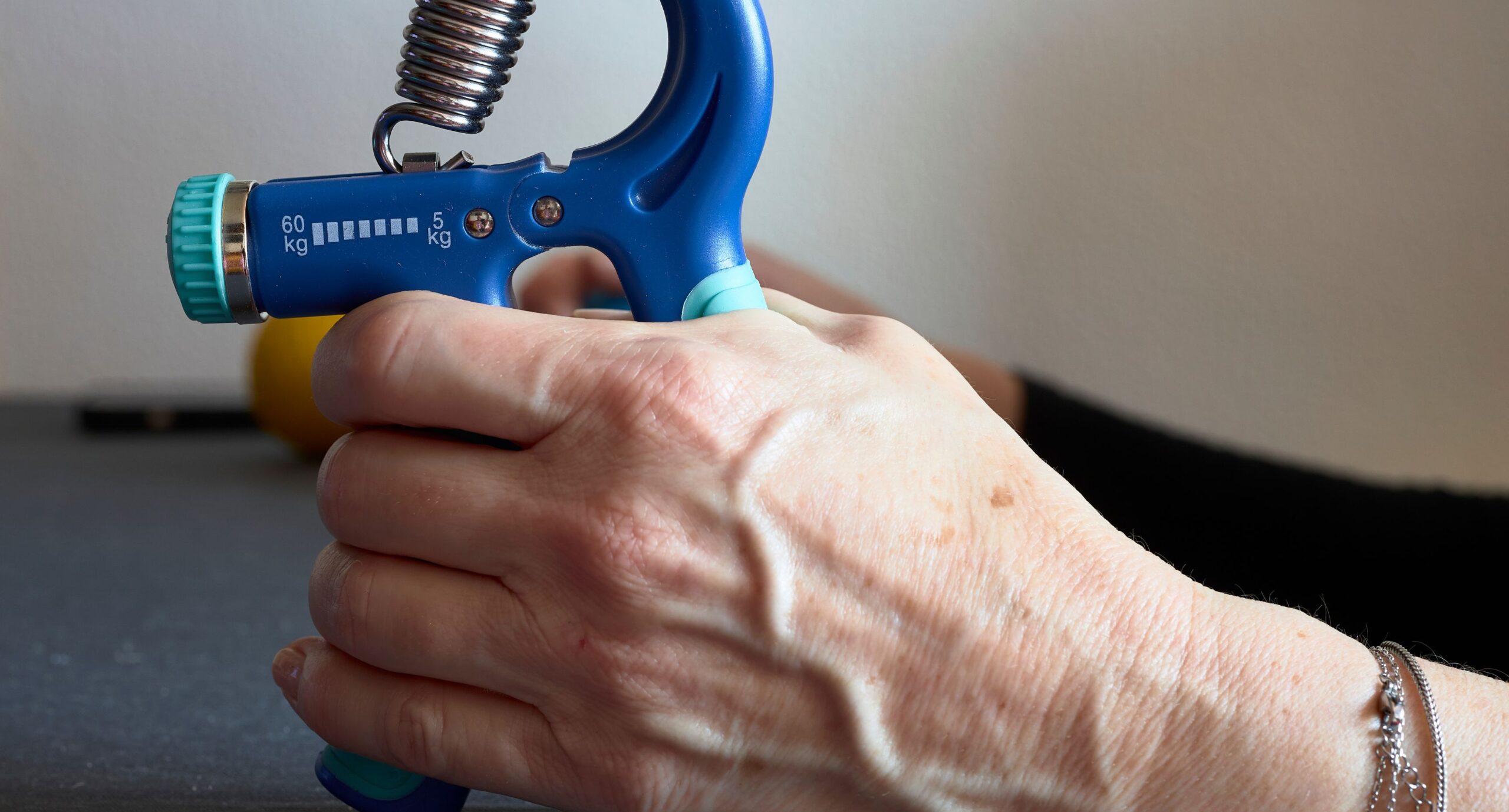
Grip strength is one of the most powerful single markers of overall physical robustness and future health risk. It isn’t just about how strong your hands are. Low grip strength usually reflects lower muscle mass and poorer muscle quality across the whole body, and it has been linked with higher rates of disability, fractures, hospitalisation, and all-cause mortality. In large meta-analyses, every 5 kg drop in grip strength is associated with a significantly higher risk of dying from any cause and from cardiovascular disease in particular.(2) Because it’s easy to measure and responds well to training, grip strength is often described as a “muscle vital sign” for aging.
Using a hand dynamometer is a simple and inexpensive assessment tool for assessing grip strength. Stand tall with your arm by your side, elbow straight or slightly bent, and your wrist in a neutral position (not bent forward or backward). Hold the dynamometer in one hand, then squeeze as hard as you possibly can for about three to five seconds, without swinging your arm or leaning your body into it. Relax, rest for at least 30 seconds, and repeat two or three times, then record the best value for that hand. Switch sides and do the same on the other hand. Exact “normal” values depend on age and sex, but several large studies suggest that older adults generally want to stay well above roughly 28–30 kg for men and 18–20 kg for women to avoid falling into the “weak” or high-risk category.(3) You want to aim to be at least in the healthy mid-range for your age and sex, and treat any clear downward trend over time as a warning sign rather than waiting until you are below a cut-off.
Another way to test grip is with a dead hang from a pull-up bar. Hanging from a secure overhead bar challenges your hands, forearms, shoulders and upper back all at once, and is widely used to build and assess grip strength in athletes. Step or climb up to a sturdy bar, take a shoulder-width overhand grip, and gently ease your feet off the support so you’re hanging with straight arms and relaxed shoulders. Start the timer as soon as you’re fully hanging. Newer or deconditioned adults often start around 10 seconds; with training, working toward holding a solid, controlled dead hang for 30–45 seconds is a strong sign of good grip endurance and upper-body stability. As with the dynamometer, the key longevity insight is the trend: being able to hang longer over time, or at least maintaining your hang duration as you age, suggests your muscular system is staying robust. Anyone with painful shoulder, elbow or hand problems should ease into this test cautiously or seek advice first.
To actually improve grip strength, the big levers are regular strength training and specific “grip-heavy” exercises. Dead hangs themselves are one of the best tools: doing two to three sets of 10 to 30 seconds a few times per week quickly builds capacity, and you can progress by adding time or moving toward one-arm variations. Carries such as farmer’s walks (holding heavy dumbbells or kettlebells at your sides while you walk), heavy rows, and pull-up or lat-pulldown variations all force the hands to work hard and translate directly into stronger grip strength over time. Other simple exercises like using a heavier resistance band, or doing a few sets of squeezes with a gripper—help, especially for older adults who are starting from a low base. You don’t want to just test your grip; train it deliberately two to three times per week and look for small but steady increases in your best squeeze or hang time.
2. Sitting–rising test
The sitting-rising test (SRT) asks one simple question: how easily can you get down to the floor and back up again without using your hands or knees for support? It sounds trivial, but studies of middle-aged and older adults have found that participants with the lowest scores (needing the most support) had much higher mortality than those who could sit and stand smoothly with little or no help.(4) Each single point increase in SRT score has been associated with a meaningful improvement in survival, suggesting that this one movement captures a lot about your underlying musculoskeletal health.
To perform the test at home, you need a small clear space on a non-slippery floor, ideally with a mat if the surface is hard. Start standing upright with your feet loosely crossed, barefoot or in flat shoes, and with nothing nearby that might trip you. From there, lower yourself down to a sitting position on the floor, using as little help from your hands, knees, or elbows as possible. Once you’re seated, reverse the movement: stand back up to your original position, again trying to avoid using your hands, knees, or other parts of your body as props. It’s wise for anyone who is older, deconditioned, or unsteady to have a friend nearby the first time they try this to reduce the risk of falls.
Researchers typically score the test out of 10 points: 5 for the way you sit down and 5 for the way you get up. You start each phase with 5 points and lose 1 point every time you use a hand, knee, or forearm to help you, and lose half a point for wobbling or losing balance. Someone who can sit and rise without any support and with good control scores a perfect 10; someone who needs multiple supports and is unstable may score in the 0–4 range. In studies, people in that lowest range have had dramatically higher death rates—from natural and cardiovascular causes—than those scoring 8–10, even after adjusting for age and other factors.(4) To note: a low score is not a prediction carved in stone, but a clear signal that improving strength, mobility, and balance should be a priority. Because all three can be trained, it’s entirely possible to move from a low SRT score into a safer range over time.
To get better at it, train the movements that support it. Practice getting up and down from the floor regularly. Work on bodyweight squats, split squats, step-ups, and controlled lunges. Add hip mobility drills, ankle mobility work, and gentle floor transitions such as kneeling, half-kneeling, and deep squat holds. The test is not only about strength; it is also about comfort moving through the floor-to-standing pattern, which many adults stop practicing as they age.
3. Gait speed
Gait speed is simply how fast you walk at your usual pace, but in older adults it turns out to be a remarkably strong predictor of survival. A large pooled analysis of more than 34,000 people aged 65 and older found that each 0.1 m/s increase in usual walking speed was linked with roughly a 10 to 12 per cent reduction in risk of death. At age 75, predicted 10-year survival in that analysis ranged from under 20 per cent for the very slowest walkers to well over 80 per cent for the fastest.(5) Walking speed is so powerful because it integrates cardiovascular fitness, leg strength, balance and nervous-system function into one simple, everyday behaviour.
You can measure it at home with just a tape measure and a stopwatch. Mark out a straight 6-metre (about 20-foot) stretch of flat, non-slippery ground—a hallway or a flat section of driveway works well—and put a piece of tape at the start and finish. Wear the shoes you normally walk in and use any walking aid you may rely on day to day. Stand at the start line, relax, and then walk to the other end at your normal, comfortable pace, not a forced march. Have someone start the timer when your first foot moves and stop it when your torso crosses the finish line. Divide the distance by the time to get your walking speed in metres per second: if it takes 5 seconds to cover 6 metres, that’s 1.2 m/s.
In research settings, usual walking speeds below about 0.8–1.0 m/s are typically treated as a marker of higher risk and frailty, while faster usual speeds are associated with better function and longer life.(6) For home use, the absolute number is less important than the direction of change. A gradual slowing of your natural walking speed over years can signal underlying issues—loss of strength, cardiovascular problems, neurological changes or accumulating illness—that deserve attention.
Walking speed improves with walking itself, but not just casual strolling. Brisk walking, hill walking, intervals, and regular aerobic training all help. Strength training matters too because the legs need force to produce efficient movement. If walking has slowed down, the answer is rarely to “just walk more” in a vague sense. It is to build the physical systems that support faster, stronger, more confident gait.
4. Single-leg balance
Balance is rarely treated as a vital sign, but it should be. Being able to stand on one leg for just 10 seconds without support is strongly associated with lower risk of death in middle-aged and older adults. One study reported that people over 50 who could not hold a 10-second single?leg stance had roughly an 80% higher risk of dying over the next seven years compared with those who could, even after adjusting for age and health conditions.(7) This simple test taps into the health of the brain, nerves, muscles, joints, and inner ear—all the systems that keep you upright and off the floor.
To do the test safely, stand near a kitchen counter, sturdy table, or heavy chair so you can grab it if needed. With shoes off or in flat, grippy footwear, stand tall with your arms by your sides. Shift your weight onto one leg and gently lift the other foot off the floor, either hovering it or resting it lightly against your standing leg’s calf. As soon as the foot leaves the floor, start timing. The goal is to hold steady for up to 10 seconds without letting the raised foot touch down, without hopping, and without grabbing the support surface; if any of those things happen, the attempt ends. After a brief rest, repeat on the other leg.
This test matters because balance depends on the interaction of the feet and ankles, hips, vision, inner ear, nervous system, and core and leg muscles. When balance begins to decline, the body becomes more vulnerable to falls, and falls are a major threat to healthy aging. Even if someone remains otherwise strong, poor balance can dramatically affect confidence and independence.
How do you improve it? Start with practice. Single-leg stands done regularly are one of the best ways to build balance. Begin with both hands near support, then progress by using one hand, then no hands. You can also practice standing on one leg while brushing your teeth, doing tandem stance, or walking heel-to-toe in a controlled line. Strength training helps too, especially exercises that build the ankles, calves, hips, and core.
5. Chair stand test
The chair stand test looks like a simple “get up from a chair” drill, but it is a powerful indicator of lower-body strength, muscular endurance and functional independence. Studies in older adults show that people who can perform chair stands more quickly, or complete more repetitions in 30 seconds, tend to have lower risk of disability and death than those who struggle, even after accounting for how much they exercise overall.(8) Because standing up from a chair mimics everyday tasks like getting on and off the toilet, out of a car or up from the sofa—it tells you directly how well your legs and hips are coping in real life.
For the commonly used 30-second version, place a stable, armless chair against a wall so it cannot slide. Sit toward the front of the seat with your feet flat on the floor, about hip-width apart, and your knees bent roughly 90 degrees. Cross your arms over your chest or rest your hands lightly on your shoulders so you can’t push off your thighs. When you start the test, stand up fully so your hips and knees straighten, then sit back down in a controlled way until you make light contact with the chair. Repeat that cycle as many times as possible in 30 seconds, counting only full stands. For most adults, a useful target is roughly 8 to 14 stands in 30 seconds, with 10 or more being a strong result and fewer than 8 suggesting below-average lower-body function. For a timed version instead, choose a fixed number of repetitions—five or ten—and measure how long it takes you to complete them with good form.
Lower scores on this test—fewer stands in 30 seconds or very slow times for a fixed number of reps—are a red flag that leg strength and power are below what’s ideal for healthy aging. At the same time, this test doubles as training: regularly practising controlled chair stands is one of the simplest ways to build stronger quads, glutes and core, all of which support walking, climbing stairs and getting off the floor. Step-ups, lunges, goblet squats, and leg presses also help. If the goal is endurance, repeat moderate sets with shorter rest periods. If you feel pain in your knees, hips or back during the movement, it’s sensible to back off and get some professional guidance. Otherwise, aiming to add one or two repetitions over a few months, or shave a couple of seconds off your time, is a very concrete, motivating way to measure progress. The key is consistency, because lower-body capacity responds well to training even later in life.
Putting it all together
Each test has rough targets, but the most important pattern across all of them is the same: know your baseline, re-test every few months, and pay attention to trends. If your scores are holding or improving, you’re stacking more strength, stability, and resilience for the future. If they’re sliding, it’s a prompt to act now, not later.
The other unifying theme is that every single test is trainable. That is the real power of these assessments: they don’t just measure where you are, they show you exactly where to focus your training so you can age with more capacity, more confidence, and more vitality!
The real lesson here is not that one test can predict lifespan, but that physical function is one of the clearest signs of how well you are aging. A body that can balance, rise, walk, and grip well is a body that is more prepared for the challenges of later life. That is healthspan in action.
Yours in health,
Dr. Nathalie
Dr. Nathalie Beauchamp, B.Sc., D.C., IFMCP is the author of the book—Hack Your Health Habits: Simple, Action-Driven, Natural Solutions For People On The Go, and the creator of several online health education programs. Dr. Nathalie’s mission is to educate, lead and empower people to take control of their health. She recently launched a new book https://smartcuts.life/
For health strategies and biohacking tips sign up for her newsletter at www.drnathaliebeauchamp.com
Photo credit: © Ricardo Jato de Evan via Canva.com
References
- Webber, S. C., Porter, M. M., & Menec, V. H. (2010). Mobility in older adults: A comprehensive framework. The Gerontologist, 50(4), 443–450. https://doi.org/10.1093/geront/gnq013
- Leong, D. P., Teo, K. K., Rangarajan, S., Lopez-Jaramillo, P., Avezum, A., Orlandini, A., Seron, P., Ahmed, S. H., Rosengren, A., Kelishadi, R., Rahman, O., Iqbal, R., Gupta, R., Lear, S. A., Oguz, A., Yusoff, K., Zatonska, K., Chifamba, J., Igumbor, E. T., … Yusuf, S. (2015). Prognostic value of grip strength: Findings from the Prospective Urban Rural Epidemiology (PURE) study. The Lancet, 386(9990), 266–273. https://doi.org/10.1016/S0140-6736(14)62000-6
- Chen LK, Woo J, Assantachai P, Auyeung TW, Chou MY, Iijima K, Jang HC, Kang L, Kim M, Kim S, Kojima T, Kuzuya M, Lee JSW, Lee SY, Lee WJ, Lee Y, Liang CK, Lim JY, Lim WS, Peng LN, Sugimoto K, Tanaka T, Won CW, Yamada M, Zhang T, Akishita M, Arai H. Asian Working Group for Sarcopenia: 2019 Consensus Update on Sarcopenia Diagnosis and Treatment. J Am Med Dir Assoc. 2020 Mar;21(3):300-307.e2. doi: 10.1016/j.jamda.2019.12.012. Epub 2020 Feb 4. PMID: 32033882.
- de Brito, L. B. B., Ricardo, D. R., de Araújo, D. S. M. S., Ramos, P. S., Myers, J., & de Araújo, C. G. S. (2014). Ability to sit and rise from the floor as a predictor of all-cause mortality. European Journal of Preventive Cardiology, 21(7), 892–898. https://doi.org/10.1177/2047487312471759
- Studenski, S., Perera, S., Patel, K., Rosano, C., Faulkner, K., Inzitari, M., Brach, J., Chandler, J., Cawthon, P., Connor, E. B., Nevitt, M., Visser, M., Kritchevsky, S., Badinelli, S., Harris, T., Newman, A. B., Cauley, J., Ferrucci, L., & Guralnik, J. (2011). Gait speed and survival in older adults. JAMA, 305(1), 50–58. https://doi.org/10.1001/jama.2010.1923
- Middleton A, Fritz SL, Lusardi M. Walking speed: the functional vital sign. J Aging Phys Act. 2015 Apr;23(2):314-22. doi: 10.1123/japa.2013-0236. Epub 2014 May 2. PMID: 24812254; PMCID: PMC4254896.
- Araujo, C. G. S., de Souza e Silva, C. G., Laukkanen, J. A., de Mello, V. D. F., Villela, P. H., de Lima, J. R. P., de Albuquerque, C., Oliveira, G. P., Ribeiro, F. C., & de Brito, L. B. B. (2022). Successful 10-second one-legged stance performance predicts survival in middle-aged and older individuals. British Journal of Sports Medicine, 56(17), 975–980. https://doi.org/10.1136/bjsports-2021-105360
- Bandinelli S, Milaneschi Y, Ferrucci L. Chair stands test and survival in the older population. J Am Geriatr Soc. 2009 Nov;57(11):2172-3. doi: 10.1111/j.1532-5415.2009.02544.x. PMID: 20121975; PMCID: PMC4587495.